
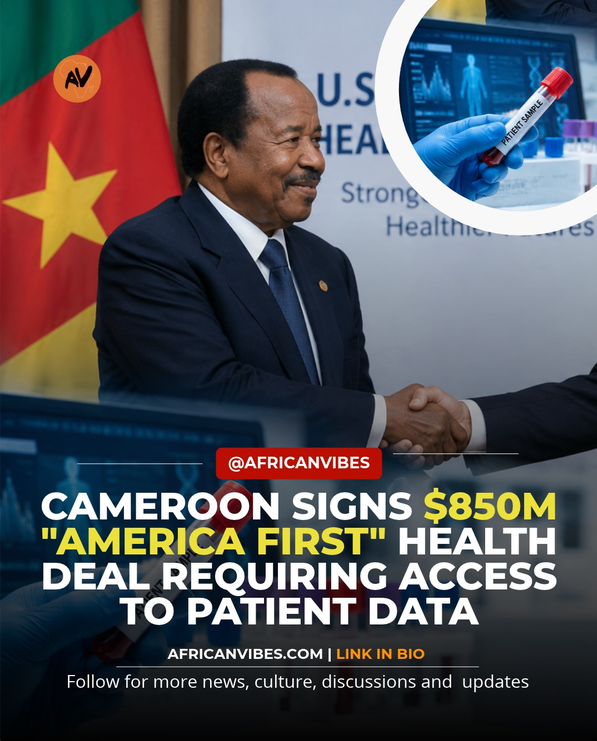
Cameroon has signed the funding agreement for an $850 million health partnership with the United States, locking in a five-year program tied to a separate, binding agreement that requires the country to hand over patient samples and related data to Washington within five days of a request. Those samples can then be passed on to as many as 10 U.S. companies or other private entities
Economy Minister Alamine Ousmane Mey and U.S. Chargé d’affaires Brenda Soya signed the Strategic Objective Grant Agreement in Yaoundé on October 1, 2026. It puts into operation the Cameroon US health deal first signed on December 16, 2025, under the Trump administration’s America First Global Health Strategy.
The program is worth about 510 billion FCFA in total: about 240 billion FCFA from Washington and about 270 billion FCFA in new health spending by Cameroon itself. The documents commit Cameroon to sharing samples and data, and they tie that commitment to the aid.
What the Cameroon US Health Deal Requires on Samples and Data
The data commitments sit in a three-page Specimen Sharing Agreement, signed the same day as the December memorandum and published by the U.S. State Department. It took effect on January 15, 2026, and runs for 10 years, renewable every five.
It covers “specimens, samples, sequencing data, and any other associated data” linked to new and emerging infectious diseases with epidemic or pandemic potential. Routine hospital records fall outside its scope.
Under Article 2, Cameroon must begin sharing within five days of a U.S. request. The agreement then states: “The Government of Cameroon consents to the U.S. Government sharing the specimen and related data” with up to 10 “non-U.S. Government U.S. entities” able to develop tests, vaccines or treatments. None of those entities are named.
The memorandum also includes protections. Health data systems are to be hosted on servers “under the jurisdiction of the Government of Cameroon,” intellectual property and “full rights over national data” stay with Cameroon, sample transfers must follow Cameroonian law “including protection of human subjects,” and U.S. audits exclude military, security and classified data.
Where the $850 Million Goes
U.S. funding starts at $100.9 million in 2026 and falls each year to $47.9 million in 2030, totaling $399.3 million. Cameroon commits to raising its own health spending by $450 million over the same period. If it falls short, the U.S. cuts its contribution dollar for dollar.
The program funds HIV, tuberculosis and malaria medicines, laboratories, disease surveillance and about 5,000 health worker positions, which Cameroon is expected to take over as U.S. support ends in 2031. Targets include cutting maternal deaths from 258 to 140 per 100,000 live births and reducing malaria deaths among children under five from 1,370 to 825 a year by 2030.
The memorandum also commits Cameroon to expanding HIV prevention, including the long-acting injectable lenacapavir “in the future.” As of September 29, Cameroon had not yet been offered lenacapavir supply, according to Think Global Health.
Cameroon can only decline in what the text calls “exceptionally rare circumstances,” such as when too little sample exists. Even then, it may not share that sample with anyone else, and it must hand over any new samples from the same case within 24 to 48 hours of them becoming available.
What Cameroon Gets in Return
If a medicine or vaccine is developed mainly from Cameroonian samples, the U.S. commits to prioritize Cameroon’s request “immediately behind the U.S. Government’s domestic need,” subject to the availability of funds. Washington will make “best efforts” to offer it at or below the price the U.S. government pays. Cameroon would still have to buy it.
The agreement also reaches past its own end date. If Cameroon pulls out, termination “shall not affect the use by the U.S. Government of any specimens and related data previously shared.”
Aid Tied to Compliance
The funding promises in the main memorandum of understanding are not legally binding. Section 6.9 states that the memorandum “is not an international agreement and does not give rise to legal rights and obligations.” The specimen agreement, by contrast, is a published international agreement.
The two are linked. Both documents state that if Cameroon fails to meet its sharing commitments, the U.S. may change its planned assistance or end the memorandum altogether.
The memorandum adds further obligations:
- One-day alerts. Cameroon must notify the U.S., including its embassy in Yaoundé, within one day of detecting a public health emergency of international concern “or any threat whose spread poses an immediate risk to national security.”
- A national biobank. The U.S. plans to fund one by the end of 2026.
- Digitized patient records. Cameroon commits to rolling out an AI-powered tool called ScanForm to digitize HIV patient-level data and malaria data in all health facilities by 2028, with the memorandum noting “opportunities for U.S. companies.”
- Audit access. Cameroon must give the U.S. “any data access, on-site access, or other information” needed to audit up to 5% of health facilities, the medicine supply chain, its own health spending accounts, and compliance with the Helms Amendment, the U.S. law barring aid money from funding abortion.
The memorandum also includes protections. Health data systems are to be hosted on servers “under the jurisdiction of the Government of Cameroon,” intellectual property and “full rights over national data” stay with Cameroon, sample transfers must follow Cameroonian law “including protection of human subjects,” and U.S. audits exclude military, security and classified data.
Where the $850 Million Goes
U.S. funding starts at $100.9 million in 2026 and falls each year to $47.9 million in 2030, totaling $399.3 million. Cameroon commits to raising its own health spending by $450 million over the same period. If it falls short, the U.S. cuts its contribution dollar for dollar.
The program funds HIV, tuberculosis and malaria medicines, laboratories, disease surveillance and about 5,000 health worker positions, which Cameroon is expected to take over as U.S. support ends in 2031. Targets include cutting maternal deaths from 258 to 140 per 100,000 live births and reducing malaria deaths among children under five from 1,370 to 825 a year by 2030.
The memorandum also commits Cameroon to expanding HIV prevention, including the long-acting injectable lenacapavir “in the future.” As of September 29, Cameroon had not yet been offered lenacapavir supply, according to Think Global Health.
Source: African Vibes, “Cameroon Signs $850M ‘America First’ Health Deal Requiring U.S Have Access to Patient Samples and Data” (Governance section)
https://africanvibes.com/cameroon-us-health-deal-patient-samples-data/